Manufacturing Innovation with Humanoid Robots: A New Paradigm in Industrial Sites by 2026
 Editor
As of early 2026, the humanoid robot market is experiencing unprecedented growth in the manufacturing sector. According to the latest report by global market research firm IDC, the market for humanoid robots in manufacturing is expected to increase from $2.3 billion in 2025 to $3.4 billion in 2026, a 47.8% rise. This figure significantly surpasses the annual growth rate of 12% for the traditional industrial robot market. Notably, humanoid robots, which resemble human form and movement, are beginning to handle not only simple repetitive tasks but also complex assembly, quality inspections, and even creative problem-solving.
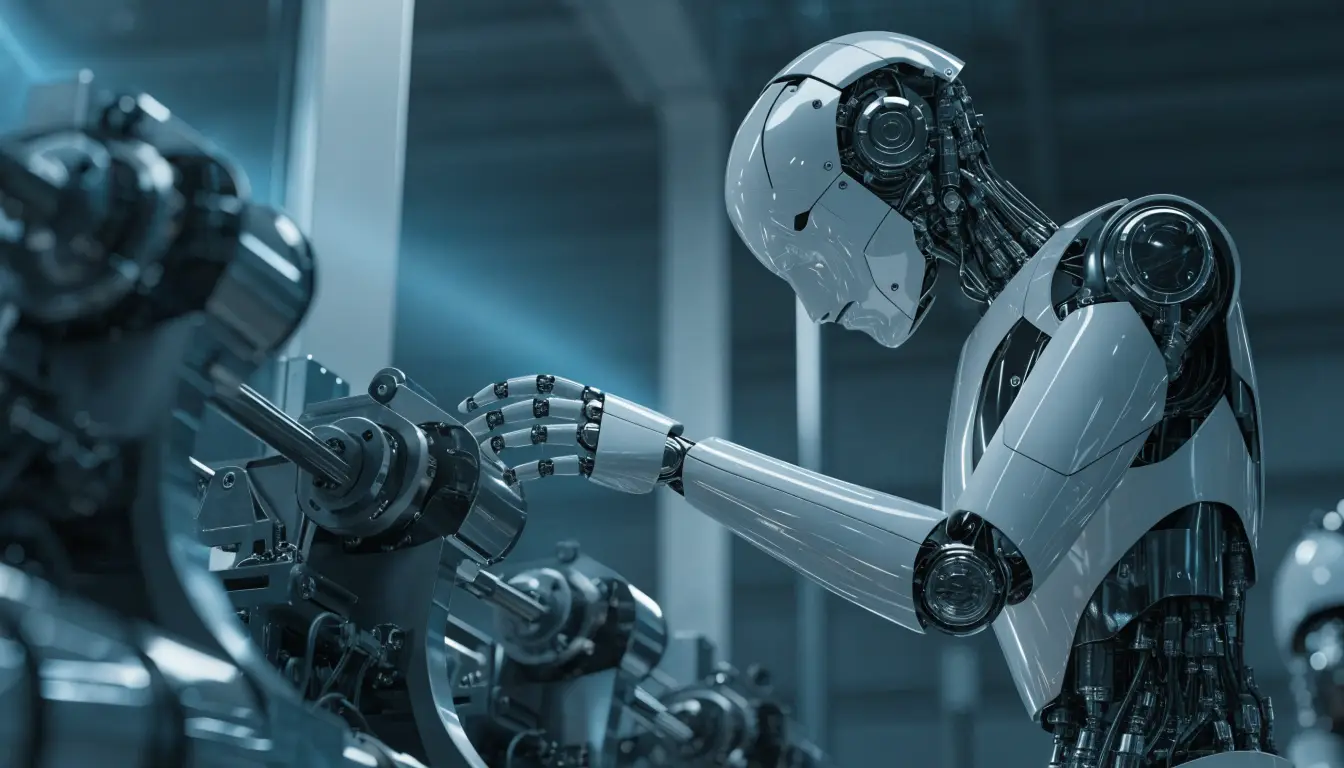
At the core of this transformation are several key technological innovations. Firstly, AI-based real-time learning capabilities have significantly improved. California-based Tesla’s Optimus robot began its pilot testing in the fourth quarter of 2025 and is now deployed in battery cell assembly at the Texas Gigafactory, achieving an accuracy rate of 99.7%. Tesla announced plans to deploy 1,000 Optimus units on its production lines by the end of 2026. Meanwhile, Japan’s Honda is developing the ‘E2-DR’, a successor to ASIMO, which is being trialed on the car assembly line at its Ohio plant, demonstrating 85% efficiency compared to skilled technicians in complex wiring tasks.
The acceleration of humanoid robots in manufacturing is closely linked to labor shortages. According to a 2025 survey by the National Association of Manufacturers (NAM), 77% of U.S. manufacturers are experiencing a shortage of skilled workers, a 15 percentage point increase from 2020. The situation is more severe in Korea, where the number of manufacturing employees decreased by 3.2% compared to 2023, according to Statistics Korea. In this context, humanoid robots are gaining attention not merely as a replacement for human labor but as a new form of workforce capable of continuous 24-hour operation and collaboration with humans.
Technological Advancements and Performance Metrics
The technical performance of currently commercialized humanoid robots has reached an impressive level. The latest version of Boston Dynamics’ Atlas achieves a walking speed of 1.5 meters per second and can lift objects weighing 20kg. More impressive is its precision manipulation capability, allowing fine force control in 0.1 Newton increments through pressure sensors at its fingertips. This meets the requirements for electronic component assembly and precision machining. Shanghai-based UBTECH Robotics’ Walker X demonstrates millimeter-level accuracy in bimanual coordination tasks and has been successfully tested on smartphone assembly lines.
Significant improvements have also been made in energy efficiency. Tesla’s Optimus consumes 2.3kWh of power per hour, which is 40% lower than existing industrial robots. Advances in battery technology have extended continuous operation time from 8 to 12 hours. Japan’s SoftBank Robotics’ industrial model of Pepper has reached a level where it can operate in outdoor work environments by combining a solar charging system. These technological advancements are directly contributing to reduced operating costs, shortening the payback period from the previous 5 years to 2.8 years.
The integration of artificial intelligence and machine learning technologies has greatly enhanced the adaptability of humanoid robots. The Digit robot by UK-based Agility Robotics, in collaboration with Google DeepMind, can learn new tasks in an average of 72 hours through reinforcement learning. This is comparable to the time it takes for human workers to master new tasks. More importantly, once a skill is learned, it can be immediately shared with other robots via the network. This ‘collective learning’ capability exponentially increases the efficiency of the entire production line.
Global Market Trends and Competitive Landscape
Examining regional market conditions, the Asia-Pacific region accounts for 52% of the global humanoid robot market. China has emerged as the largest market, recording a scale of $700 million as of 2025. In line with China’s ‘Five-Year Plan for the Development of the Robot Industry’, a national investment of $1.5 billion is planned by 2026. Despite its relatively small market size ($120 million), Korea is standing out in terms of technological innovation. Hyundai Motor announced that its self-developed humanoid robot ‘H-Bot’, deployed in welding tasks at its Ulsan plant, has improved work accuracy by 15%.
The European market is growing with a focus on safety regulations and worker protection. Germany’s KUKA, in collaboration with BMW, has installed 50 collaborative humanoid robots at its Munich plant, where they perform car interior assembly tasks alongside human workers. Swiss-based ABB reported an 89% increase in humanoid robot division sales in the fourth quarter of 2025 compared to the same period the previous year. The North American market is vibrant with technological innovation and venture investment, with Silicon Valley’s Figure AI raising $600 million in a Series B round in 2025, recognizing a company valuation of $2.6 billion.
Clear differentiation strategies among competitors are also emerging. Tesla is adopting a vertically integrated approach using its proprietary AI chips and neural networks, achieving optimization between hardware and software. In contrast, Japanese companies focus on precision and stability. Toyota Motor is applying its TPS (Toyota Production System) to humanoid robots, aiming for defect-free production. Honda is expanding its application field to construction sites by developing robots capable of working on unstable ground, based on bipedal walking technology accumulated from ASIMO.
Innovative approaches by startups are also noteworthy. Norway’s 1X Technologies (formerly Halodi Robotics) is proposing a hybrid model combining remote operation and autonomous work. Their NEO robot allows human operators to intervene remotely in complex situations, making it useful in work environments where full automation is challenging. Canada’s Sanctuary AI is developing the ‘Phoenix’ robot, which mimics human cognitive abilities, and is testing it at Canadian Tire’s logistics center. This robot demonstrates over 95% accuracy in recognizing and sorting products of various sizes and shapes.
In terms of market segmentation, distinct trends are emerging by application. Automotive manufacturing forms the largest market, accounting for 35% of total humanoid robot demand. Electronics assembly follows at 28%, and metal processing at 18%. Notably, demand in the semiconductor manufacturing sector is surging, with Taiwan’s TSMC announcing plans to introduce humanoid robots in new fabs starting in 2026. The strategy is to leverage the advantage of robots having a lower contamination risk than humans in cleanroom environments.
From an investment perspective, the humanoid robot market is in its early growth stage as of 2026, and is expected to maintain a high annual growth rate of 42% over the next five years.
Positive signals are also emerging in cost-efficiency analysis. As of 2026, the average purchase price of humanoid robots is around $150,000, a 30% decrease compared to 2023. With mass production and component standardization underway, it is expected to drop to $100,000 by 2027. When calculated as total cost of ownership (TCO), including operating costs, humanoid robots begin to show cost advantages from the third year compared to the annual labor cost of one worker (average $60,000). Considering their ability to operate 24 hours, the actual cost efficiency is even higher.
Safety and regulatory environments are also important considerations. The U.S. Occupational Safety and Health Administration (OSHA) released workplace safety guidelines for humanoid robots in December 2025, providing specific standards for safety distances, emergency stop systems, and hazard detection sensors during human-robot collaboration. The European Union takes a stricter approach, classifying humanoid robots as ‘high-risk AI systems’ under the AI Act. Accordingly, manufacturers must meet requirements for transparency, explainability, and human oversight. Korea is establishing autonomous safety standards through the K-Robot certification system, which aids domestic companies in securing technological competitiveness.
Workforce management and retraining issues are also emerging as major concerns. According to a 2025 study by the McKinsey Global Institute, the introduction of humanoid robots is expected to change approximately 4 million manufacturing jobs worldwide by 2030. However, this does not simply mean job reduction but a change in job content. New occupations such as robot management, programming, and maintenance are being created, and existing workers are transitioning to more complex and creative tasks. Germany’s Siemens is investing €50 million annually in employee retraining programs to prepare for these changes, developing collaboration skills with robots as a core competency.
As of 2026, the introduction of humanoid robots in manufacturing is no longer at an experimental stage but is established as a practical productivity enhancement tool. With technological maturity and economic viability surpassing critical thresholds, large-scale commercialization is expected within the next 2-3 years. For investors, this is a market with high growth potential, but technological risks and regulatory uncertainties must also be considered. Successful investment requires an understanding of the entire ecosystem, including not only robot manufacturers but also sensors, AI software, and battery technology. It is particularly important to balance the analysis of the rapid growth of the Asian market and the strengthening safety regulations in Western markets.
*This analysis is intended for general informational purposes and is not an investment recommendation or solicitation. Investment decisions should be made at one’s own discretion and responsibility.*
