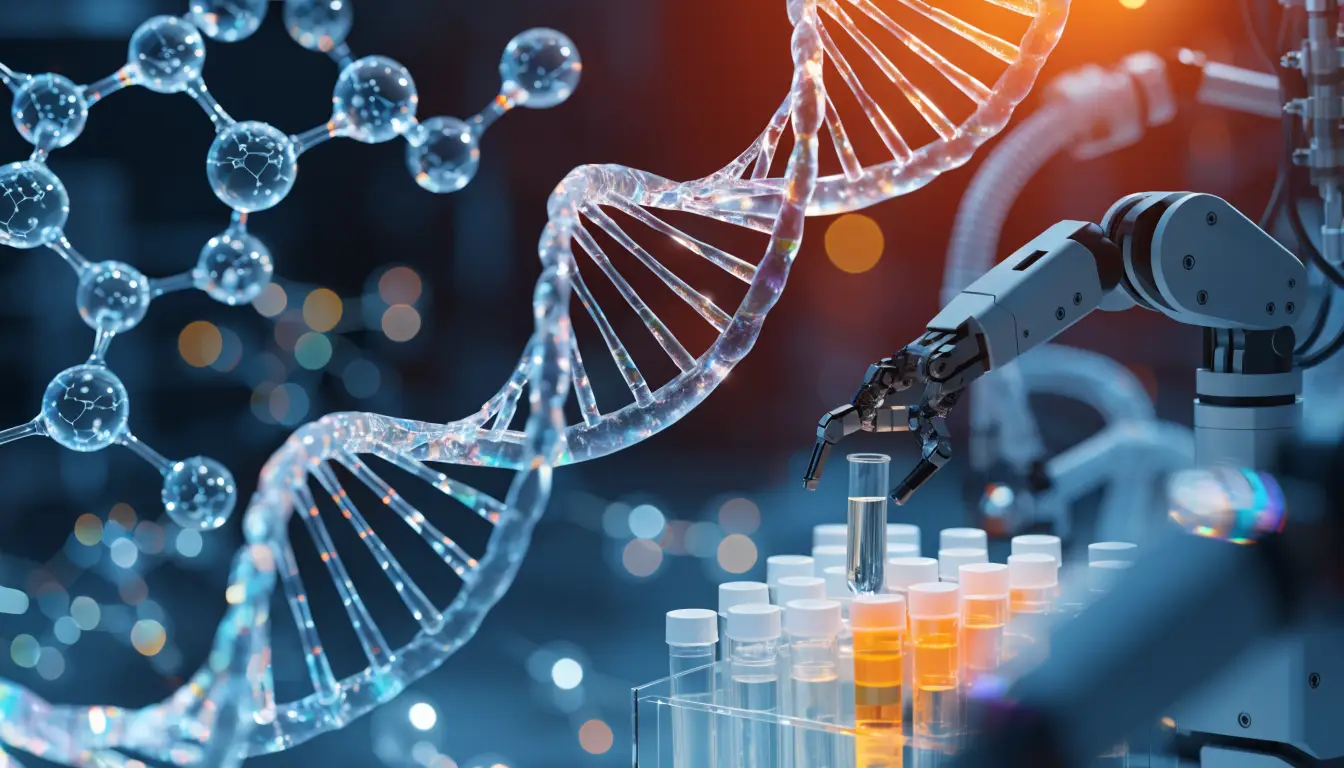
Biotech Convergence Revolution: The New Healthcare Ecosystem Created by AI-Bio Synergy in 2026
 Editor
AI Revolution in the Biotech Industry: Status in 2026
As we enter the first week of 2026, the biotech industry is experiencing the most radical transformation in history due to the convergence of artificial intelligence and robotics technology. The global biotech market has reached a scale of 1.24 trillion dollars, growing by 18.7% compared to 2025, with the AI-bio convergence sector accounting for 210 billion dollars, driving overall growth. Particularly, the Korean biotech market has emerged as the second largest in the Asia-Pacific region after China, recording a growth of 23.4% year-on-year to reach 18.7 billion dollars, thanks to the successful implementation of the K-Bio Belt project.
The core drivers of this growth are the commercialization of AI-based drug development platforms and the popularization of robotic automation systems. According to an industry report released in the fourth quarter of 2025, AI-assisted drug development processes have reduced development time by an average of 4.2 years and cut costs by 67% compared to traditional methods. Roche, headquartered in Basel, Switzerland, discovered 12 new drug candidates in 2025 alone through its AI platform ‘Genentech.AI’, a 300% increase over traditional methods. Johnson & Johnson in New Jersey, USA, also announced that it has significantly improved the success rate of immuno-oncology drug development from 8.3% to 24.7% using its proprietary machine learning algorithm.
The achievements of Korean biotech companies are also noteworthy. Samsung Biologics in Songdo, Incheon, recorded a revenue of 3.12 trillion won in 2025, growing by 28.4% year-on-year, and improved production efficiency by 37% with the introduction of an AI-based process optimization system. Celltrion in Yeonsu-gu, Incheon, reduced development costs by 43% with its self-developed biosimilar AI analysis platform and announced the launch of three new biosimilars in the first half of 2026. These achievements are analyzed as the result of the Korean government’s ‘K-Bio New Deal 2.0’ policy and an annual R&D investment of 2.5 trillion won.
Realization of Personalized Medicine and Market Innovation
The most notable change in the biotech industry in 2026 is the full-scale commercialization of personalized medicine. With the cost of genome analysis plummeting from $1,000 in 2020 to $127 now, the personalized therapeutics market has grown by 156% compared to 2025, reaching a scale of 89 billion dollars. Illumina, headquartered in San Diego, California, has commercialized technology that completes whole genome analysis within 24 hours through its next-generation sequencing (NGS) platform ‘NovaSeq X Plus’, reducing analysis time by 75% compared to previous methods.
The most innovative advancement in the field of personalized medicine is the introduction of AI-based drug response prediction systems. Novartis in Basel, Switzerland, commercialized its ‘AI-PharmProfile’ system in 2025, which provides optimal drug and dosage recommendations by comprehensively analyzing a patient’s genetic characteristics, lifestyle, and medical history. This system showed an average improvement of 34% in treatment efficacy and a 52% reduction in side effects compared to existing therapies in clinical trials. Pfizer in New York, USA, also announced that its similar AI platform ‘PfizerOne’ improved the accuracy of selecting the optimal treatment for cancer patients to 87%.
Domestically, the ‘K-Precision’ platform, jointly developed by Seoul National University Bundang Hospital and Samsung Medical Center, is gaining attention. Based on a genome database specialized for Koreans, the pilot operation results in 2025 showed a 25% higher treatment prediction accuracy for Korean patients compared to algorithms targeting Western populations. Notably, it has achieved groundbreaking results in developing personalized treatment protocols for high-incidence cancers in Koreans, such as gastric and liver cancer. Based on these achievements, the Korean personalized medicine market is expected to grow to 4.2 billion dollars in 2026, a 67% increase from the previous year.
Advancements in robotics technology are also accelerating innovations in personalized medicine. The surgical robot market has reached a scale of 7.8 billion dollars, growing by 31% compared to 2025, with the introduction of AI-based autonomous surgical systems spreading. The ‘da Vinci 5′ system developed by Intuitive Surgical in Sunnyvale, California, features real-time analysis of patient biometric data during surgery to automatically adjust the optimal surgical path. This system reduced the complication rate in prostate cancer surgeries by 41% compared to previous methods and shortened surgery time by an average of 23%.
In the field of new treatment development, the cell and gene therapy (CGT) market is experiencing explosive growth. The global CGT market has grown by 89% compared to 2025, reaching a scale of 15.6 billion dollars, with CAR-T cell therapies and gene editing technologies being the main growth drivers. Novartis’ Kymriah and Gilead Sciences’ Yescarta recorded combined sales of 4.7 billion dollars in 2025, setting a new standard in blood cancer treatment. Domestically, GC Cell’s CAR-T therapy ‘GC027’ received approval from the Ministry of Food and Drug Safety in 2025 and is set for commercialization, showing a 68% improvement in survival rates compared to existing treatments in phase 3 clinical trials.
The impact of robotics and automation technology on the bio-manufacturing sector is also significant. The bio-manufacturing automation market has grown by 44% compared to 2025, reaching a scale of 18.9 billion dollars, with the introduction of continuous manufacturing technology accelerating. Samsung Biologics has established a fully automated continuous manufacturing line at its fourth plant in Songdo, improving productivity by 156% compared to previous methods and significantly enhancing product quality consistency. These automation technologies are gaining more attention as interest in supply chain stability has increased following the COVID-19 pandemic.
Optimizing clinical trials using artificial intelligence is also a key area of biotech innovation. AI-based patient recruitment platforms have reduced the average recruitment period for clinical trial participants by 34% and improved the accuracy of selecting suitable patients to 89%. BenevolentAI in London, UK, has achieved remarkable results in the ‘drug repositioning’ field, discovering new indications for existing approved drugs through its AI platform. In 2025, the company discovered through AI analysis that an existing drug approved for Parkinson’s disease is also effective for Alzheimer’s disease, with phase 2 clinical trials currently underway.
The convergence of biotech and digital healthcare is also creating new market opportunities. The digital therapeutics market has grown by 78% compared to 2025, reaching a scale of 13.4 billion dollars, with innovative solutions emerging particularly in the fields of mental health, diabetes, and cardiovascular diseases. Pear Therapeutics in Boston, USA, developed the digital therapeutic ‘reSET’ for addiction treatment, which showed a 42% improvement in treatment success rates when used alongside existing therapies. Domestically, the diabetes management app ‘Noom’, developed by Welt, has secured 4.5 million monthly active users in the global market, demonstrating a successful case of overseas expansion.
Changes in the regulatory environment are also accelerating biotech innovation. The US FDA announced the ‘AI/ML-Based Medical Devices Action Plan 2.0’ in 2025, significantly simplifying the approval process for AI-based medical devices, resulting in an 89% increase in AI medical device approvals compared to the previous year. The European Medicines Agency (EMA) also expanded the fast-track approval pathway for innovative therapies through the ‘Regulatory Science Strategy 2025-2030’. The Korean Ministry of Food and Drug Safety also eased the conditional approval criteria for innovative biopharmaceuticals through the amendment of the ‘Advanced Regenerative Medicine and Advanced Biopharmaceuticals Safety and Support Act’ in 2025, contributing to the global competitiveness of domestic biotech companies.
Looking at investment trends, global venture capital investment in the biotech sector increased by 23% year-on-year to 28.7 billion dollars in 2025. Particularly, investment in AI-bio convergence startups reached 7.8 billion dollars, accounting for 27% of the total, emerging as the most active investment field. In Korea, biotech investment has also become active, with total investment in 2025 increasing by 34% year-on-year to 2.14 trillion won. Particularly, the government’s K-Bio Grand Challenge program is investing 500 billion won annually to nurture next-generation biotech companies.
The outlook for the biotech industry in 2026 is very bright. Industry experts predict that with the continued advancement of AI and robotics technology, the success rate of new drug development will improve from the current 12% to 25% by 2030. Additionally, the personalized medicine market is expected to grow at an average annual rate of 34%, reaching a scale of 340 billion dollars by 2030. The Korean biotech industry is also expected to expand its global market share from the current 4.2% to 7.8% by 2030, thanks to continued government support and corporate innovation efforts. Amid this growth trend, biotech companies are expected to secure new growth engines through technological innovation and strengthening global partnerships.
This article is for informational purposes only and is not intended as an investment solicitation or advice. Investment decisions should be made at one’s own discretion and responsibility, and it is advisable to consult with a professional before making any decisions.