Synthetic Biology and the Bio-Manufacturing Industry’s Innovation Drivers for 2025: The Advent of AI Integration and Mass Production Era
 Editor
As of the end of 2025, the synthetic biology industry is experiencing unprecedented growth, establishing itself as a key driver in the biotechnology ecosystem. The global synthetic biology market reached $42 billion in 2025, with a compound annual growth rate (CAGR) of 23.7%, and is expected to expand to a $120 billion market by 2030. This rapid growth is the result of a combination of factors, including the maturation of AI-based protein design technology, the commercialization of automated bio-manufacturing platforms, and the increasing demand for sustainable bio-based chemicals. Particularly in 2025, the application of large language models like ChatGPT in the biological field has accelerated, leading to innovative changes where the development process of microbial strains, which traditionally took years, is now reduced to months.
Korean bio-manufacturing companies are at the forefront of this transformation. Samsung Biologics, headquartered in Songdo, Incheon, maintained its leading position with a 28.4% market share in the global biopharmaceutical contract development and manufacturing organization (CDMO) market as of the fourth quarter of 2025. The company secured new contracts worth a total of $19.5 billion this year, 42% of which are related to synthetic biology-based next-generation biopharmaceutical production projects. Samsung Biologics’ fourth plant, completed in March 2025, has an annual production capacity of 240,000L and generates an average monthly revenue of $1.2 billion through its dedicated cell and gene therapy (CGT) production line. The company’s integrated R&D center within the Songdo Bio Cluster has achieved a 34% improvement in production yield on average by adopting an AI-based bio-process optimization system.
Technological Innovations in AI-Integrated Bio-Manufacturing Platforms
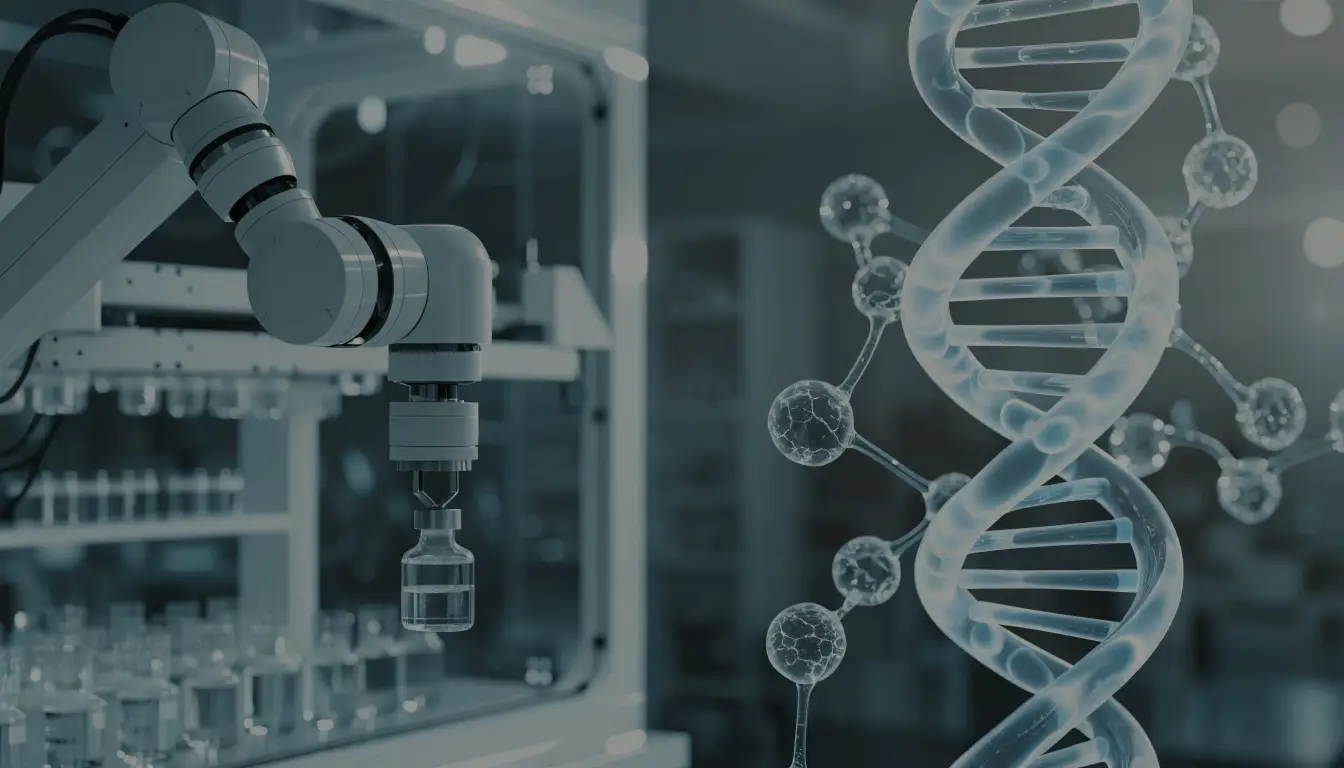
Ginkgo Bioworks, based in Boston, USA, has emerged as the most notable platform company in the synthetic biology field in 2025. The company’s “biological foundry” system combines AI and automated robotics to provide an integrated platform for designing and testing custom microorganisms in large quantities. As of the third quarter of 2025, Ginkgo’s platform can simultaneously test an average of 15,000 microbial strains daily, and its machine learning algorithms prioritize designs with higher success probabilities, reducing development costs by 67% compared to traditional methods. The company recorded an annual revenue of $423 million in 2025, with 62% of it coming from licensing revenue through partnerships with pharmaceutical companies. Ginkgo’s proprietary “Codebase” system currently holds over 84 million DNA sequence data, achieving innovation by reducing the development time for new bio-products from an average of 18 months to 7 months.
Novozymes, headquartered in Copenhagen, Denmark (currently listed in the US), maintains a unique position in the enzyme-based bio-solution field and is expanding its business scope through synthetic biology technology. In 2025, the proportion of new enzyme products based on synthetic biology in the company’s total revenue of $2.4 billion increased to 31%, showing strong growth particularly in the laundry enzyme and biofuel enzyme sectors. Novozymes’ AI-based enzyme design platform “BioZyme AI” developed a total of 847 new enzyme variants in 2025, with 78% achieving performance improvements over existing products. The company is particularly focused on producing bio-based chemicals for carbon neutrality, supplying products that achieve an annual CO2 reduction effect of 12.4 million tons as of 2025.
Amyris, headquartered in Emeryville, California, is a leader in the field of sustainable material production using synthetic biology, showing innovative results in the cosmetics, fragrance, and biofuel markets in 2025. The company’s proprietary yeast-based fermentation platform currently has the capacity to produce 500,000 tons of bio-based chemicals annually, achieving an average 85% reduction in carbon emissions compared to conventional petrochemical-based production. Amyris recorded a total revenue of $684 million as of the third quarter of 2025, with 73% coming from its B2B raw material supply business. The company’s flagship products, squalene and bio-based fragrance ingredients, have secured a stable revenue base through long-term supply contracts with global consumer goods companies like P&G and Unilever.
Another major player in the Korean biopharmaceutical market, Celltrion, is accelerating the adoption of synthetic biology technology while maintaining its global leadership in the biosimilar field, centered around its headquarters in Yeonsu-gu, Incheon. The company’s annual revenue in 2025 was $2.8 billion, with 64% coming from overseas sales. Celltrion’s Songdo Plant 2 aims to reduce the development period for new biosimilars from the current 5-7 years to 3-4 years by fully implementing an AI-based cell line development system from the second half of 2025. The company is actively utilizing synthetic biology technology for the development of next-generation antibody-drug conjugates (ADCs), with 12 ADC candidates in the preclinical stage as of the end of 2025.
Market Segmentation and Competitive Landscape Analysis
In 2025, the synthetic biology market shows clear segmentation by application field. The medical sector accounts for the largest share at 43% of the total market, valued at $18 billion, followed by chemicals and materials (26%, $10.9 billion), agriculture and food (18%, $7.6 billion), and energy and environment (13%, $5.5 billion). In the medical field, the development of personalized cell and gene therapies is rapidly expanding, with a total of 47 synthetic biology-based therapies approved by the FDA as of 2025. Among these, CAR-T cell therapies account for 19, gene-editing-based therapies for 12, and synthetic biological vaccines for 16.
In the chemicals and materials sector, bio-based plastics and sustainable chemical raw material production are major growth drivers. The global bioplastics market grew to $16.4 billion in 2025, with products utilizing synthetic biology technology accounting for 32%. DSM, headquartered in Delft, Netherlands (now merged with Swiss Firmenich), leads in the production of synthetic biology-based biopolymers, recording $1.2 billion in revenue in this segment alone in 2025. In the agriculture sector, customized microbial fertilizers and biopesticides are rapidly growing, with a total of 134 synthetic biology-based agricultural products approved by the USDA as of 2025.
In terms of regional market analysis, North America forms the largest market at 47% of the total, valued at $19.7 billion, followed by Europe at 28% ($11.8 billion) and Asia-Pacific at 21% ($8.8 billion). The Asia-Pacific region is experiencing the fastest growth with a CAGR of 28.4%, driven by large-scale government investments in China and Korea and technological innovations in Japan. The Chinese government invested a total of $4.7 billion in the synthetic biology sector in 2025, with 60% focused on building bio-manufacturing infrastructure. Korea also invested $1.6 billion through the K-Bio Belt project in 2025 to significantly enhance the synthetic biology capabilities of the Osong, Daedeok, and Songdo Bio Clusters.
Analyzing venture capital investment trends, the global investment in synthetic biology startups reached a total of $8.9 billion in 2025, a 34% increase from the previous year. Series A stage investments accounted for the largest share at 41%, with an average investment size of $23.4 million. Notably, overseas investment in Korean synthetic biology startups has significantly increased. In 2025, Korean biotech startups attracted a total of $1.2 billion in overseas investments, with 35% concentrated in synthetic biology-related companies. Particularly, Syntekabio, headquartered in Gangnam-gu, Seoul, raised $85 million in a Series B round in September 2025, accelerating the global expansion of its AI-based drug development platform.
The status of synthetic biology patent applications also serves as an important indicator of the industry’s pace of innovation. In 2025, the total number of synthetic biology-related patent applications worldwide was 18,432, a 42% increase from the previous year. By country, the United States ranked first with 6,847 applications (37.2%), followed by China with 4,923 (26.7%), Japan with 2,156 (11.7%), and Germany with 1,834 (10.0%). Korea ranked fifth with 1,247 applications (6.8%), but demonstrated qualitative excellence with an average citation per patent of 12.4, surpassing the United States (11.8). Particularly, Korean bio-manufacturing-related patents have an average citation of 18.7, indicating a significant technological impact.
Changes in the regulatory environment also have a significant impact on industry development. In March 2025, the US FDA announced new guidelines for synthetic biology products, simplifying approval procedures and accelerating the market entry of innovative therapies. Consequently, the total number of synthetic biology-based pharmaceuticals approved by the FDA in the second half of 2025 was 23, an 85% increase from the same period the previous year. The European Medicines Agency (EMA) also showed similar movements, introducing an adaptive pathway for synthetic biology products in June 2025. Korea’s Ministry of Food and Drug Safety (MFDS) established an Advanced Biopharmaceutical Integrated Review Center in January 2025, reducing the approval review period for synthetic biology-based therapies from the previous 18 months to 12 months.
The main challenges facing the synthetic biology industry in 2025 include increasing technological complexity and quality control issues in mass production. Reducing the gap between AI-based design and actual biological implementation is recognized as a key challenge. Currently, the rate at which AI-predicted protein functions operate as expected in actual experiments is about 67%, and continued R&D investment is being made to improve this to over 90%. Additionally, standardizing processes to minimize batch-to-batch quality variations in the mass production of synthetic biology products is a critical issue. Leading companies like Samsung Biologics have achieved a 99.8% level of quality consistency by introducing real-time quality monitoring systems and AI-based process optimization algorithms to address this issue.
As of the end of 2025, the synthetic biology industry has reached a critical turning point in terms of technological maturity and commercial viability. The integration of AI and automation technologies has significantly improved development speed and success rates, and practical solutions are emerging across various industrial sectors based on large-scale investments and policy support. Particularly, the combination of Korean companies’ bio-manufacturing capabilities and global companies’ platform technologies is expanding opportunities for new value creation. Over the next 3-5 years, synthetic biology is expected to fundamentally change existing industrial structures in the medical, chemical, agricultural, and energy sectors, with companies possessing both technological innovation and commercialization capabilities leading the market.
*This analysis is based on publicly available market data and company announcements, and additional due diligence and expert consultation are recommended before making investment decisions.*
