The AI Integration Revolution in Biotechnology: A New Paradigm for Precision Medicine and Drug Development by 2026
 Editor
In early 2026, the biotechnology industry is experiencing its most radical transformation in history through integration with artificial intelligence. The global BioAI market size has increased by 45% compared to 2025, reaching $38.7 billion, emerging as a game-changer in the traditional fields of drug development and diagnostics. Especially in the field of Precision Medicine, AI-based solutions are demonstrating verified results in actual clinical settings, drawing the attention of investors and pharmaceutical companies. Samsung Biologics (Incheon, Korea) recently announced in its Q4 2025 earnings report that it improved production efficiency by 23% through AI-based bio-manufacturing optimization, setting a new benchmark across the industry.
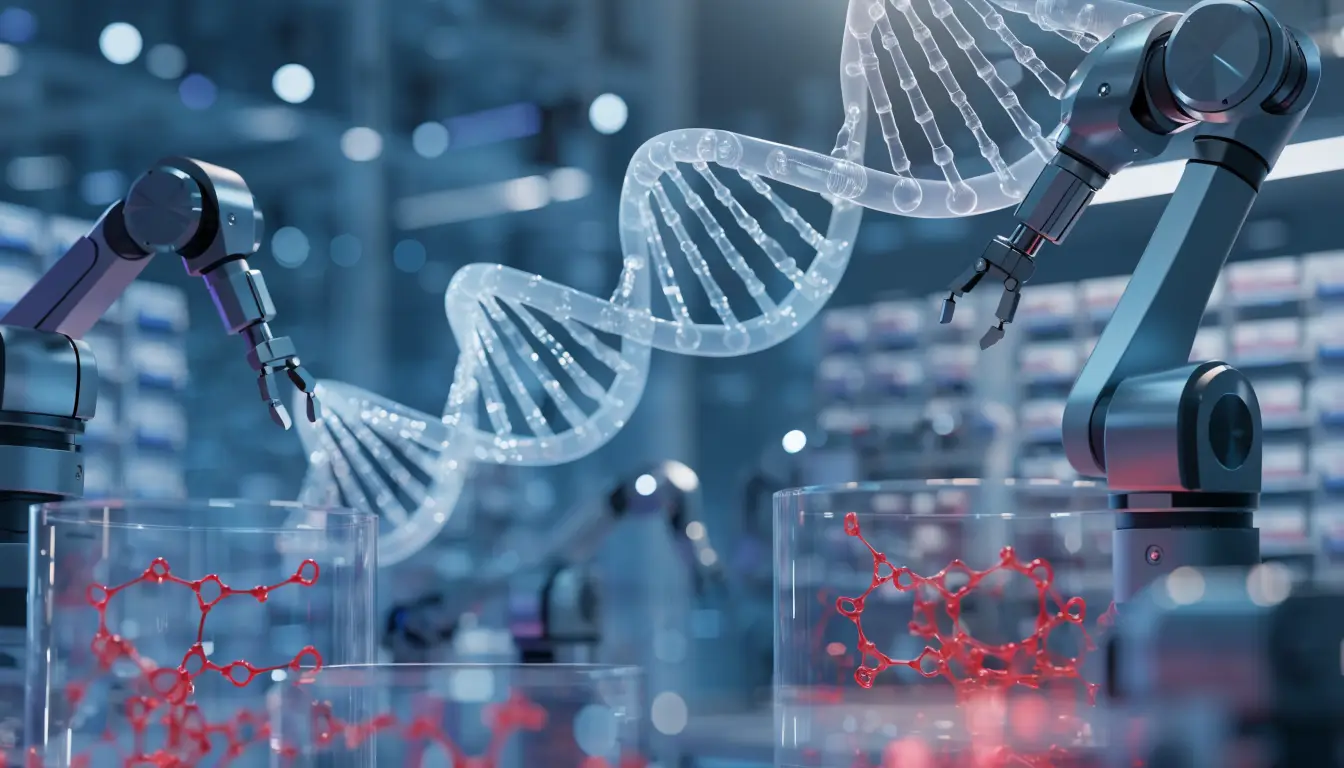
Currently, the major trends leading the BioAI market can be categorized into three main areas. First, the commercialization of AI-based drug discovery platforms is in full swing. AlphaFold3, developed by DeepMind (London, UK), predicted over 2 million protein structures by the end of 2025, with the number of new drug candidates discovered using this data increasing by 340% year-on-year. Second, the accuracy of AI for genomic analysis aimed at developing personalized therapies has improved dramatically. Illumina’s (San Diego, California) latest NovaSeq X Plus system reduced genomic sequencing error rates to below 0.1% through AI algorithms and shortened analysis time by 60% compared to previous methods. Third, the combination of biosensors and AI for real-time patient monitoring and prognosis prediction has reached the commercialization stage.
The application of AI in drug development is showing more concrete results in 2026. Roche (Basel, Switzerland) announced that its AI-based drug development platform has reduced the traditional 10-15 year drug development period to an average of 7-9 years. This is because AI can filter out high-risk candidates early on by predicting toxicity and analyzing efficacy in the preclinical stage. In fact, 32% of Roche’s 2025 R&D investment, amounting to $4.1 billion, was allocated to AI-related projects, improving the clinical success rate of drug candidates under development from 12% to 19%. Meanwhile, Johnson & Johnson (New Brunswick, New Jersey) successfully discovered new indications for existing approved drugs through its AI-based drug repurposing program, launching eight new therapies in 2025 alone.
Korea’s biotech ecosystem is also experiencing rapid growth through AI integration. Celltrion (Incheon) unveiled its AI-based antibody design platform ‘CelliGen AI’ at the end of 2025, with its first biosimilar developed through this platform receiving approval from the European Medicines Agency (EMA). This platform reduced the antibody optimization process from 18 months to 6 months and cut development costs by 40%. Celltrion’s Q4 2025 sales increased by 28% year-on-year to 784 billion won, with AI-based new product sales accounting for 15% of the total. Additionally, the Korean government announced an investment of 2.3 trillion won from 2026 to 2030 to establish a ‘BioAI Innovation Hub,’ expected to be a crucial catalyst for enhancing the AI capabilities of domestic biotech companies.
AI Innovation in the Precision Medicine Market and Global Competitive Landscape
The application of AI in the field of precision medicine is driving tangible changes in medical practice as of 2026. Thermo Fisher Scientific (Waltham, Massachusetts) developed the Ion Torrent Genexus DX system, which can propose personalized treatment plans for cancer patients within 24 hours through AI-based genomic analysis. This system is currently used in over 450 medical institutions worldwide, improving treatment response rates by an average of 34% compared to previous methods. In clinical trials for lung cancer patients, the accuracy of AI-predicted treatments reached 89%, significantly surpassing the average accuracy of 76% by specialists.
As competition intensifies in the global precision medicine market, companies are clarifying their differentiation strategies. NVIDIA (Santa Clara, California) is expanding its market share by providing GPU-based AI infrastructure to biotech companies through its Clara Discovery platform. As of Q4 2025, NVIDIA’s healthcare division revenue increased by 67% year-on-year to $2.3 billion, with BioAI-related sales accounting for 60%. NVIDIA’s H200 Tensor Core GPU improved genomic analysis speed by five times and increased protein folding prediction accuracy to 92%. In response, Intel (Santa Clara, California) and AMD (Santa Clara, California) are accelerating the development of bio-specific AI chipsets, with related product launches expected in the first half of 2026.
In the Asia-Pacific region, China and Japan are showing unique approaches in the BioAI field. BGI Genomics (Shenzhen, China) has built an East Asian-specific genomic database through its AI platform ‘DNBseq-AI’ and is actively pursuing entry into the Korean and Japanese markets. In 2025, BGI’s Asia-Pacific region revenue increased by 52% year-on-year to $1.2 billion. In Japan, SoftBank (Tokyo) led a BioAI investment fund that invested a total of $1.8 billion in related startups in 2025, an 85% increase from the previous year. Particularly, under Japan’s ‘BioDX Strategy 2030,’ the construction of a national BioAI infrastructure is accelerating, providing new collaboration opportunities for Korean companies.
AI’s influence is rapidly expanding in the clinical diagnostics field as well. The U.S. FDA approved 47 AI-based diagnostic devices in 2025, a 76% increase from the previous year. Among these, AI for pathological image analysis accounted for 23, radiology AI for 18, and genomic analysis AI for 6. Notably, Google Health’s (Mountain View, California) AI-based breast cancer screening system is currently used in 120 hospitals across the U.S., improving early detection rates by 29% compared to previous methods. Buoyed by these achievements, Alphabet’s healthcare division revenue is estimated to have increased by 43% year-on-year as of Q4 2025.
Investment Trends and Future Outlook
The investment boom in the BioAI field continues into 2026. According to global venture capital investment data, the investment in BioAI startups in 2025 totaled $15.6 billion, a 38% increase from the previous year. North America accounted for the largest share with $8.9 billion (57%), followed by the Asia-Pacific region with $4.1 billion (26%), and Europe with $2.6 billion (17%). Notably, Series A investments accounted for 42% of the total, indicating a focus on early-stage companies. In Korea, venture investment in the BioAI sector increased by 67% year-on-year to 840 billion won in 2025, accounting for 31% of total biotech investment.
Major pharmaceutical companies are also refining their AI investment strategies. Novartis (Basel, Switzerland) announced a $5 billion investment in AI-based drug development from 2026 to 2030, establishing an AI research center in Silicon Valley. Bayer (Leverkusen, Germany) entered a strategic partnership with Google Cloud to develop AI-based crop protection agents, increasing related R&D investment by 45% year-on-year in 2025. Sanofi (Paris, France) is accelerating drug development in the field of immunology through its AI platform ‘plai,’ with the first clinical trial using this platform set to begin in Q2 2026.
From a technological perspective, the core trends in BioAI for 2026 are the spread of multimodal AI and federated learning. Multimodal AI enables more accurate predictions by comprehensively analyzing genomic data, medical images, clinical records, and lifestyle information. Microsoft’s (Redmond, Washington) Azure Health Bot platform can predict patient treatment responses with 91% accuracy through this multimodal approach. Federated learning technology is gaining attention as a solution for utilizing data from multiple medical institutions amid stricter privacy regulations, currently being piloted in major hospital networks in Europe and North America.
Changes in the regulatory environment are also significantly impacting the development of the BioAI market. With the full implementation of the European Union’s AI Act in August 2025, safety requirements for medical AI systems have been strengthened. As a result, the development cost of AI-based medical devices has increased by an average of 15-20%, but quality standardization and interoperability have improved. The U.S. FDA also announced new guidelines for AI/ML-based medical devices in December 2025, simplifying the approval process for continuously learning AI systems. The Korean Ministry of Food and Drug Safety is set to implement the ‘AI Medical Device Approval and Review Guidelines 3.0’ in March 2026, which is expected to facilitate the global expansion of domestic BioAI companies.
The growth outlook for the BioAI market is very positive. According to the latest report from market research firm McKinsey, the global BioAI market is projected to grow at an average annual rate of 42%, reaching $184.7 billion by 2030. The drug development sector is expected to account for the largest share at $73.4 billion (40%), followed by precision medicine at $55.3 billion (30%), diagnostics at $36.8 billion (20%), and other sectors at $19.2 billion (10%). Regionally, while North America is expected to remain the largest market, the Asia-Pacific region is predicted to have the highest growth rate, with China’s and India’s BioAI markets expected to sustain annual growth rates of over 50%.
In conclusion, the integration of biotechnology and AI in 2026 is no longer a future technology but an ongoing industrial revolution. Korean companies are also focusing on enhancing AI capabilities and expanding international cooperation in line with these global trends, securing new growth engines with active policy support from the government. However, alongside rapid technological advancements, issues such as regulatory compliance, data security, and ethical AI development are emerging as important challenges that need to be addressed, requiring comprehensive and strategic approaches from companies.
This analysis is based on publicly available market data and company announcements, and additional due diligence and expert consultation are recommended for investment decisions.
