The AI Revolution in the Biotechnology Industry: A New Turning Point in Drug Discovery and Personalized Medicine by 2026
 Editor
The biotechnology industry is entering an unprecedented era of innovation through its integration with artificial intelligence. As of January 2026, the global AI-based drug discovery market has grown by 34.7% from the previous year, reaching a scale of $18.9 billion, fundamentally altering the paradigm of the traditional pharmaceutical industry. Particularly, drug discovery platforms utilizing machine learning and deep learning technologies have increased the success rate in the early stages of drug development from the existing 10-15% to 25-30%, drawing significant attention from the industry. This transformation extends beyond mere technological advancements, impacting pharmaceutical companies’ business models, investment strategies, and patients’ access to treatment.
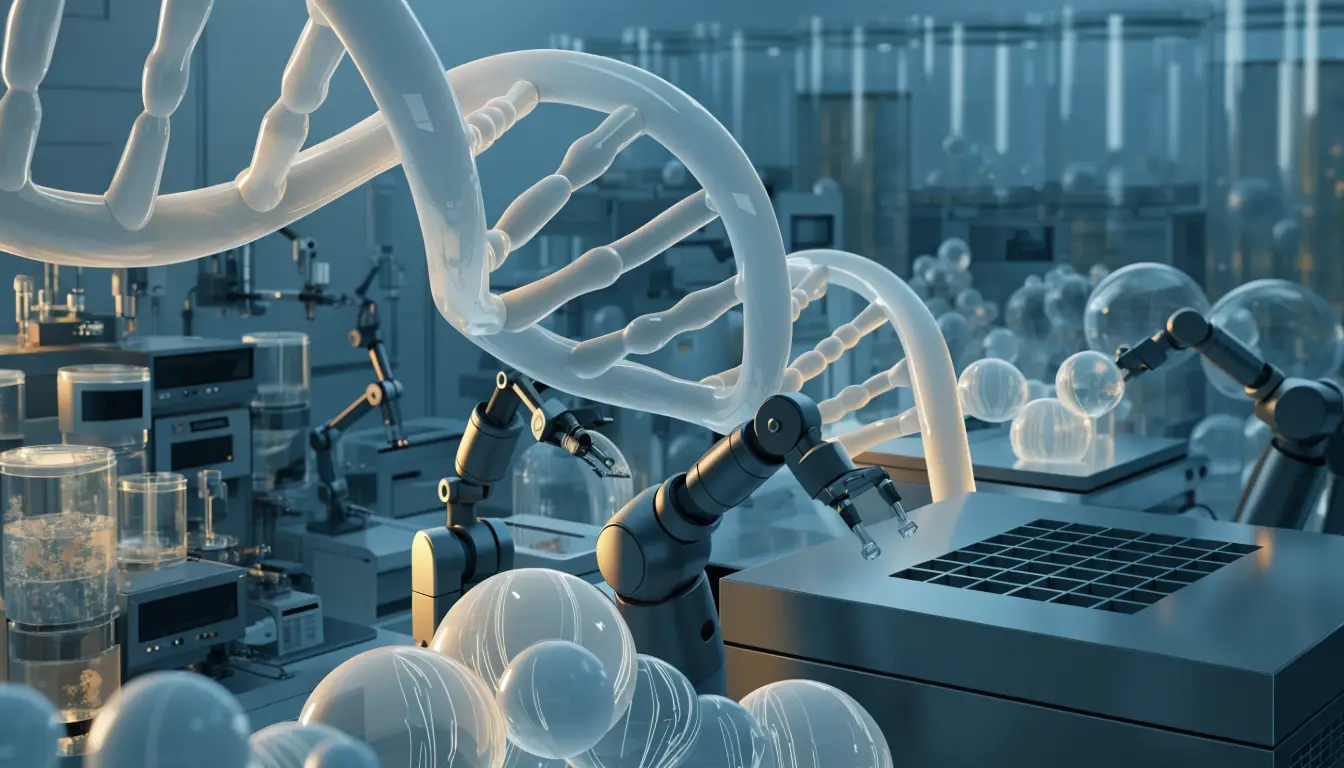
The most notable trends in the biotech field currently are AI-based drug repurposing and the development of personalized therapies. The U.S. FDA approved 47 new drugs in 2025 that heavily utilized AI, marking a 78% increase from the previous year. Notably, AI-first biotech companies like Recursion Pharmaceuticals in California and Exscientia in the UK are rapidly expanding their market share through partnerships with traditional pharmaceutical giants. In Korea, Samsung Biologics (Incheon, Gyeonggi Province) announced a 23% improvement in production efficiency by adopting an AI-based biopharmaceutical production optimization system, while Celltrion (Incheon) reported reducing the development period by an average of 18 months through an AI-assisted biosimilar development process.
Market Dynamics and Competitive Landscape of AI-Based Drug Discovery
The current AI-based drug discovery market is divided into three main groups of players. The first group includes platforms from big tech companies such as Google’s DeepMind AlphaFold and IBM Watson for Drug Discovery. The second group consists of specialized AI biotech startups like Atomwise, BenevolentAI, and Insitro. The third group comprises the internal AI capabilities of traditional pharmaceutical giants like Roche, Pfizer, and Novartis. According to a report by McKinsey in January 2026, the total investment in AI-based drug discovery is expected to increase by 28.3%, from $12.7 billion in 2025 to $16.3 billion in 2026.
Particularly noteworthy is the impact of AI on the entire drug discovery process. While the traditional drug discovery process from target identification to preclinical trials took an average of 3-6 years, AI algorithms can significantly reduce this period to 12-18 months. Atomwise in California announced in the fourth quarter of 2025 that it identified a therapeutic candidate for COVID-19 variants in just three weeks, while BenevolentAI in the UK reported significant results in repurposing existing approved drugs as Alzheimer’s treatments through AI analysis. These achievements have garnered substantial interest from investors, with venture capital investments increasing by 71.8%, from $7.8 billion in 2023 to $13.4 billion in 2025.
In terms of competitive landscape, while U.S. and European companies hold a technological edge, the pursuit from the Asian region is also noteworthy. China’s XtalPi and Insilico Medicine are demonstrating unique competitiveness in AI-based crystal structure prediction and generative AI-driven drug design, respectively. In Korea, Standigm (Seoul) has achieved results by discovering a candidate for non-alcoholic steatohepatitis (NASH) treatment through its AI-based drug development platform ‘Standigm ASK,’ securing a licensing agreement with a global pharmaceutical company. Additionally, Japan’s Preferred Networks, in collaboration with the University of Tokyo, has developed AI-based antibody design technology, with three candidate substances entering the preclinical stage by the end of 2025.
Another significant trend in the market is the surge in strategic partnerships between AI-based biotech companies and traditional pharmaceutical firms. In 2025, the number of such partnerships increased by 156% from the previous year, reaching 247 deals, with a total contract value of $8.9 billion. Notable examples include an $11 billion partnership between Roche (Basel, Switzerland) and Recursion Pharmaceuticals, and a $15 billion collaboration agreement between Gilead Sciences (Foster City, California) and Insitro. These partnerships create a win-win structure, providing AI companies with clinical trial and commercialization capabilities, while offering pharmaceutical giants innovative technology and rapid development capabilities.
New Horizons in Personalized Medicine and Precision Medicine
Another core area of AI biotechnology is the field of personalized medicine and precision medicine. As of 2026, the global precision medicine market has grown to $184.7 billion, with an annual growth rate of 12.3%. The key technologies driving this market’s growth are genomics, proteomics, and AI-based data analysis platforms. Particularly, the cost of next-generation sequencing (NGS) technology has decreased by 67% compared to 2020, significantly improving access to personal genomic analysis and accelerating the development of personalized therapies.
Illumina (San Diego, California), a leader in this field, announced in the fourth quarter of 2025 the launch of its new NovaSeq X Plus system, reducing the cost of whole-genome analysis to below $200. The industry views this as a critical turning point for the popularization of personalized medicine. Meanwhile, 10x Genomics in California has commercialized a platform that precisely analyzes the tumor microenvironment of individual cancer patients through single-cell analysis technology, already utilized by over 450 medical institutions worldwide. These technological advancements are bringing innovative changes, particularly in the field of cancer treatment, increasing the success rate of CAR-T cell therapy from the existing 40-50% to 70-80%.
Innovation in the precision medicine field is also active in the Asian region. China’s BGI Genomics (Shenzhen) announced the establishment of the world’s largest genomic database for Asians in 2025, developing disease risk prediction models specialized for Asians. In Korea, Macrogen (Seoul) completed the genomic data analysis of 100,000 Koreans as part of the K-Biomedical Hub project and announced plans to launch personalized health management services in the first half of 2026. Additionally, Japan’s RIKEN developed an AI-based drug response prediction model, achieving a 23% reduction in adverse reaction rates among Japanese patients.
A particularly noteworthy aspect of personalized medicine is liquid biopsy technology. This technology detects circulating tumor DNA or cells in bodily fluids like blood or urine for early cancer diagnosis or treatment monitoring. Guardant Health in California reported that its Guardant360 platform achieved a detection accuracy of over 90% for 15 types of cancer in 2025, currently used by over 7,500 medical institutions worldwide. Competitor Exact Sciences (Madison, Wisconsin) also secured a 65% market share in the early colorectal cancer screening market with its Cologuard product, recording $2.3 billion in sales in 2025. This growth trend is expected to continue in 2026, with the global liquid biopsy market projected to reach $6.3 billion.
Another innovation in the precision medicine field is AI-based medical imaging analysis. Google’s AI system demonstrated 6.5% higher accuracy than radiologists in breast cancer screening by the end of 2025, with a 5.7% reduction in false positives. These achievements show the potential to reduce the diagnostic burden on medical professionals and provide patients with more accurate and faster diagnoses. VUNO (Seoul) in Korea provides services to over 200 hospitals domestically through its AI-based medical imaging analysis solution ‘VUNO Med,’ and began expanding overseas in 2025, entering seven Southeast Asian countries. The company achieved 95.2% accuracy in detecting abnormalities in chest X-rays and reduced emergency room waiting times by an average of 34%.
The convergence of biotechnology and AI is also leading to innovations in business models. Moving away from the traditional blockbuster drug-centric model of the pharmaceutical industry, treatments for rare diseases targeting small patient groups and personalized therapies are emerging as new revenue drivers. The number of FDA-approved rare disease treatments increased by 83%, from 53 in 2020 to 97 in 2025, with the average annual treatment cost rising from $150,000 to $280,000. This trend is fundamentally changing pharmaceutical companies’ R&D strategies and portfolio composition, providing new opportunities for biotech startups.
From an investment perspective, the AI biotech sector is currently one of the hottest investment sectors as of 2026. Venture capital investments are expected to exceed $18 billion annually, with $4.2 billion recorded in the first quarter of 2026, up from $13.4 billion in 2025. The average investment size at the Series A stage increased by 133%, from $12 million in 2020 to $28 million in 2025, indicating that investors highly value the potential of AI biotech companies. Mergers and acquisitions by large pharmaceutical companies are also becoming more active, with AI biotech-related M&A transactions totaling $6.7 billion in 2025.
However, along with this rapid growth, several challenges are also emerging. The biggest concern is data privacy and security issues. As large volumes of personal genomic information and medical data are input into AI systems, the risk of hacking or misuse is increasing. In 2025, there were 712 incidents of medical data breaches, a 23% increase from the previous year, resulting in economic losses of $10.7 billion. Additionally, the bias problem of AI algorithms is a serious concern. Most AI models are trained on data centered around white males, leading to lower diagnostic accuracy for female or minority patients. The FDA released new guidelines for AI-based medical devices in December 2025, strengthening the regulatory framework to ensure algorithm transparency and fairness.
Changes in the regulatory environment are also significantly impacting the industry. The European Union officially implemented the AI Act in August 2025, introducing strict regulations on AI systems in the medical field, while the U.S. and China are also strengthening their respective AI medical device approval processes. While these regulatory enhancements positively impact patient safety and technology reliability, they also pose a burden by increasing development costs and time for companies. Particularly, small and medium-sized biotech companies face difficulties in securing the specialized personnel and resources needed to meet complex regulatory requirements, acting as a barrier to market entry.
The industry’s outlook for 2026 is generally optimistic. Major market research firms predict that the AI biotech market will continue to grow at a high annual rate of 28-32% over the next five years, with innovative achievements expected to continue in personalized therapies and rare disease treatments. Additionally, as next-generation technologies such as the combination of quantum computing and AI, and the convergence with synthetic biology reach commercialization stages, the pace of innovation in the biotechnology industry is expected to accelerate further. These technological advancements are ultimately expected to provide patients with more effective and accessible treatment options, significantly improving the efficiency and equity of the global healthcare system.
