The Synthetic Biology Revolution: A New Paradigm and Market Restructuring in Biomanufacturing by 2026
 Editor
A New Turning Point in Biomanufacturing
In 2026, as the field of Synthetic Biology transitions from the laboratory to commercial reality, it is fundamentally altering the traditional manufacturing paradigm. The global synthetic biology market grew from $20.8 billion in 2025 to $28 billion in 2026, a 34.6% increase, driven by the explosive interest in biomanufacturing post-pandemic. Notably, the Asia-Pacific region is leading this growth, accounting for 42% of the total market. In Korea, under the government’s ‘Biofuture Vision 2030’ initiative, there is a surge in investment in the synthetic biology sector, with a goal to expand the bioeconomy to 300 trillion won by 2026.
The key driver of this growth is the commercialization of ‘Biomanufacturing.’ The technology of producing chemicals traditionally made through petrochemical processes using microorganisms is beginning to secure economic viability. For instance, California-based Amyris (AMRS) recorded a 67% increase in Q4 2025 revenue, reaching $123 million, largely due to the significant rise in sales of biomanufactured products like synthetic vanillin and squalene. In Korea, Samsung Biologics (207940) achieved an annual revenue of 3.4 trillion won in 2025, marking a 28% growth from the previous year, with a substantial portion coming from its contract manufacturing organization (CMO) business in biopharmaceuticals.
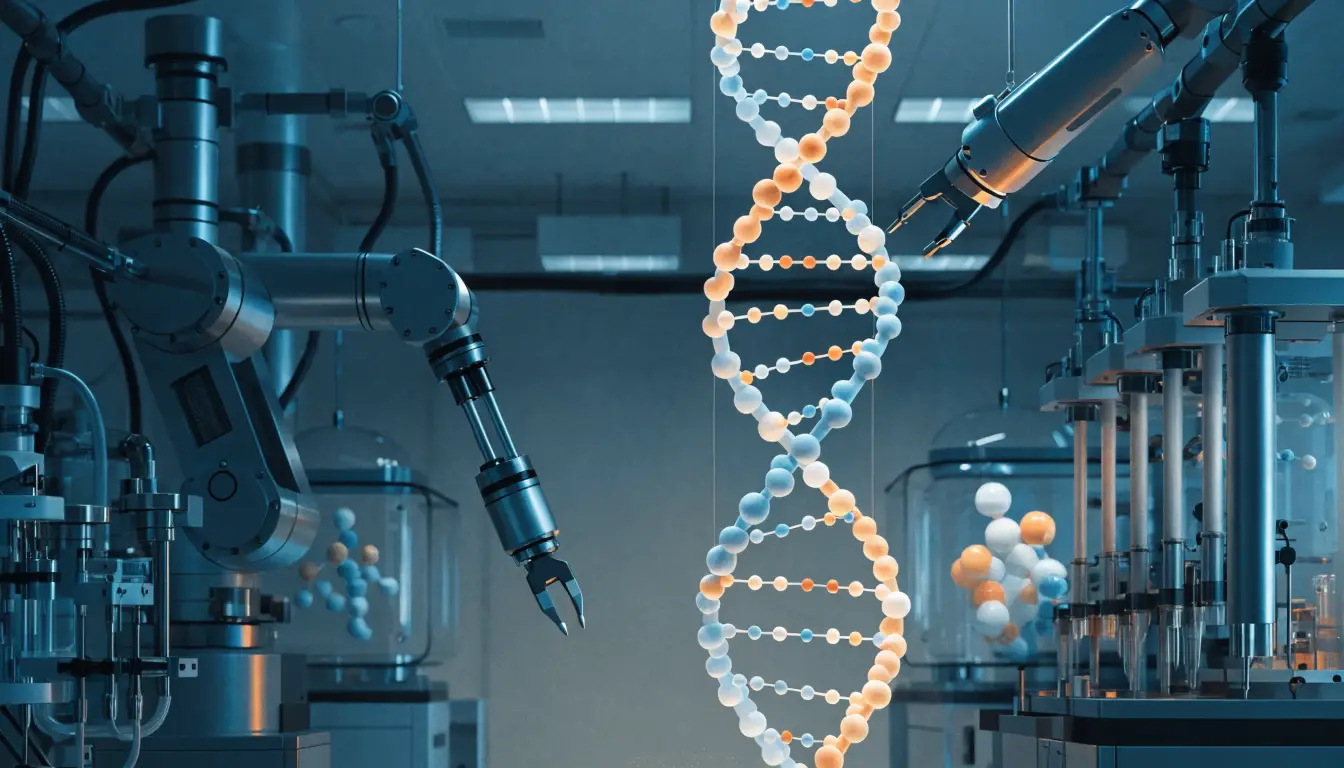
The core of synthetic biology is utilizing living organisms as ‘programmable manufacturing platforms.’ Researchers design DNA like computer code to make microorganisms produce specific chemicals. A crucial aspect of this process is ‘Metabolic Engineering,’ which involves artificially manipulating the metabolic pathways of microorganisms to efficiently produce desired substances. Boston-based Ginkgo Bioworks (DNA) has automated this approach with its ‘Biological Foundry’ platform, running over 150 projects concurrently by the end of 2025. The company’s Q4 2025 revenue was $108 million, a 45% increase from the previous year.
Market analysts predict that synthetic biology will replace existing production methods across various industries, including chemicals, pharmaceuticals, agriculture, and food. According to a recent McKinsey report, the economic value of physical inputs producible through synthetic biology is estimated to reach between $1.2 trillion and $3.6 trillion annually by 2030. This represents a significant portion of the current $4 trillion global chemical industry. Rapid growth is particularly expected in biofuels, bioplastics, and biochemical raw materials.
Strategic Positioning of Korean Companies and Global Competition
Korean companies are adopting unique positioning in the synthetic biology sector. LG Chem (051910) recorded 850 billion won in revenue from its biomaterials division in 2025, accounting for about 15% of its total revenue. Notably, LG Chem’s bio-based polyol technology can reduce carbon emissions by 40% compared to conventional petrochemical-based products. The company announced plans to invest an additional 1.5 trillion won in the biomaterials sector by 2026, interpreted as a strategic move in response to the European Union’s Carbon Border Adjustment Mechanism (CBAM).
SK Biopharm (326030) is taking a different approach, focusing on new drug development using synthetic biology. With the global sales of its epilepsy treatment ‘Cenobamate,’ approved by the FDA in 2025, revenue has surged. The company’s annual revenue in 2025 was 420 billion won, a 78% increase from the previous year. SK Biopharm is using its synthetic biology platform to develop complex new drug candidates that were challenging with traditional chemical synthesis, currently having 12 new drug candidates in its pipeline.
In the global competitive landscape, while U.S. and Chinese companies are leading, Korean companies are showing competitiveness in specific areas. China’s BGI Genomics recorded $1.5 billion in synthetic biology-related revenue in 2025, particularly strong in agricultural microbial products. Meanwhile, the U.S.’s Synthetic Biologics (SYN) specializes in medical probiotics, with its C. difficile infection prevention treatment, having completed Phase 3 clinical trials in 2025, awaiting FDA approval in the first half of 2026.
An interesting point is the impact of regulatory environments on corporate strategies. The European Union announced a new regulatory framework for synthetic biology products by the end of 2025, enhancing environmental safety and ethical considerations. Conversely, Singapore is expanding its regulatory sandbox as part of its ‘Biomanufacturing Hub’ strategy, serving as a bridgehead for many companies entering Asia. The Korean government also announced plans to enact the ‘Synthetic Biology Promotion Act’ in January 2026, expected to create a favorable environment for domestic companies.
From an investment perspective, global venture investment in the synthetic biology sector totaled $8.7 billion in 2025, a 23% increase from the previous year. Asian companies attracted $2.8 billion, accounting for 32% of the total. Korean startups are also gaining attention, with Biospectrum, developing biomanufacturing platforms, raising 45 billion won in a Series B round in December 2025, and Biotechno, developing synthetic biology-based cosmetic ingredients, receiving 30 billion won in investment. This increase in investment is interpreted as an indicator of Korea’s global competitiveness in the synthetic biology sector.
From a technical perspective, the biggest challenge currently facing synthetic biology is ‘Scale-up.’ Many companies struggle with scaling successful laboratory technologies to commercial levels. For example, Zymergen (ZY) struggled with scale-up issues before being acquired by Ginkgo Bioworks in 2022. However, there are success stories, such as Denmark’s Novozymes, which maintains its position as the world leader in enzyme production using synthetic biology, with over 60% of its $2.3 billion revenue in 2025 coming from biomanufacturing-related products.
Looking ahead, the synthetic biology market is expected to grow at an average annual rate of 28% from 2026 to 2030. This growth is primarily driven by increasing demand in biofuels, biochemicals, and biopharmaceuticals. Government policy support for achieving carbon neutrality is expected to accelerate market growth. In Korea, with the goal of increasing the bioeconomy share to 25% of GDP by 2030, continuous investment and support in the synthetic biology sector are anticipated. In this environment, the position Korean companies secure in the global market will be a crucial factor determining future national competitiveness.
*This article is intended for informational purposes only and does not constitute investment solicitation or advice. Investment decisions should be made based on individual judgment and responsibility.*
