A Pivotal Moment in South Korea’s Energy Transition by 2025: Balancing Nuclear Reactivation and Renewable Energy Policies
 Editor
A New Paradigm in Energy Transition
In 2025, South Korea’s energy policy stands at a significant turning point. According to the government’s 11th Basic Plan for Electricity Supply and Demand, a dual strategy is being pursued to increase the share of nuclear power to over 30% and renewable energy to 21.6% by 2030. This is considered a pragmatic approach to simultaneously achieving carbon neutrality and securing energy security. According to the latest data from the Korea Energy Agency, as of 2025, South Korea’s power mix consists of coal at 31.8%, natural gas at 26.9%, nuclear power at 27.4%, and renewable energy at 9.8%, marking a 3.2 percentage point increase in renewable energy compared to 2020.
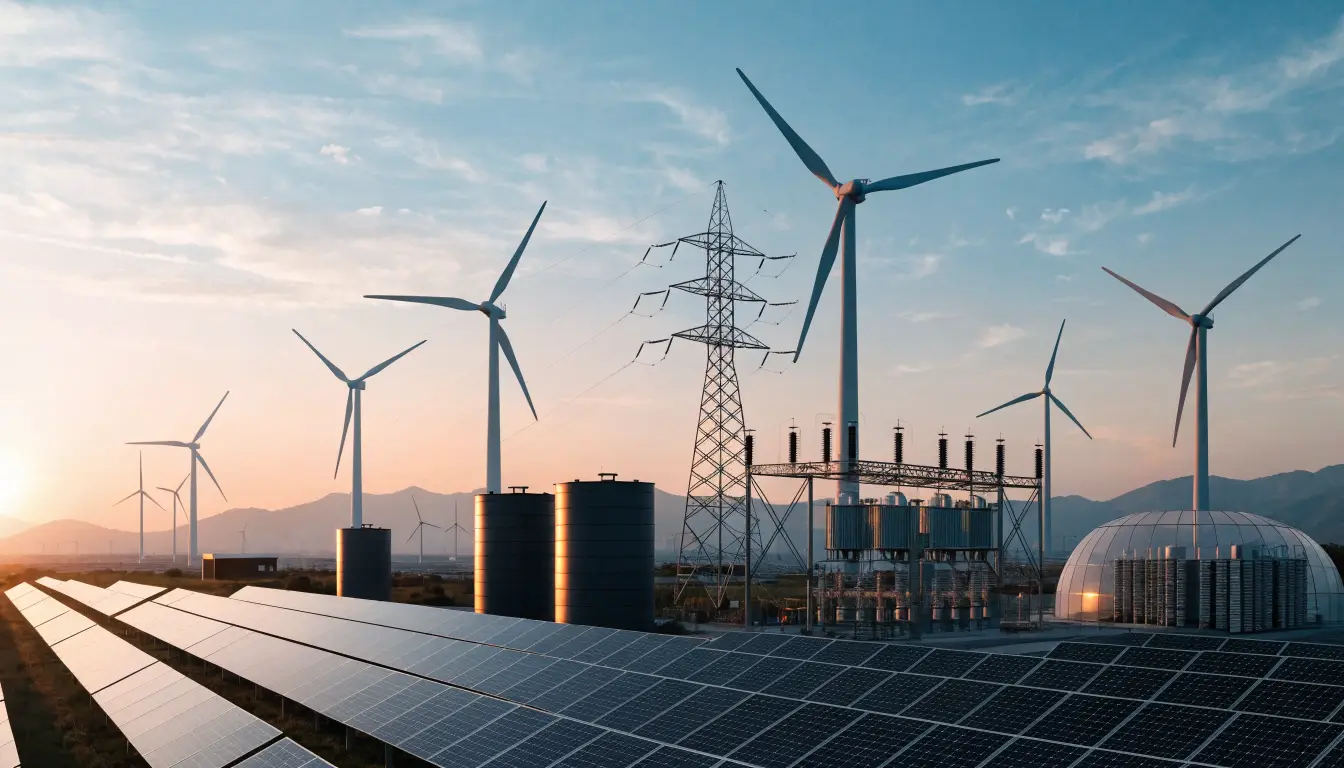
Particularly noteworthy is the shift in policy towards nuclear power. The construction of Shin Hanul Units 3 and 4 has resumed, and the extension of existing nuclear plants’ lifespans is underway. Korea Hydro & Nuclear Power (034020) operates a total of 24 nuclear reactors as of the third quarter of 2025, with a capacity of 23.25GW. This accounts for approximately 17.8% of total power generation facilities, but represents a much higher share in actual power production. The utilization rate of nuclear power is 83.2%, significantly higher than coal (68.4%) or natural gas (42.1%), underscoring its increasing importance as a base load power source.
In the renewable energy sector, solar and wind power are leading the charge. As of 2025, solar power capacity has increased by about 70% to 21.2GW compared to 2020, and wind power has grown by approximately 50% to 2.1GW. According to the Korea Energy Agency’s renewable energy statistics, solar power generation accounts for 26.8TWh annually, representing 4.7% of total power production. Although this is lower than Germany (9.7%) or Japan (8.5%), it is a significant improvement from 2.1% in 2020. The government has announced plans to expand solar capacity to 30.8GW and wind power to 17.7GW by 2030.
The biggest challenge in the energy transition process is ensuring the stability and economic viability of the power grid. To address the intermittency of renewable energy, the energy storage system (ESS) market is rapidly growing. Korean battery manufacturers such as Samsung SDI (006400) and LG Chem (051910) are taking the lead in the global ESS market, with domestic ESS installations reaching 4.2GWh as of 2025, ranking third in the world. Samsung SDI announced that its ESS business revenue increased by 45% year-on-year to 1.8 trillion won in the third quarter of 2025, accounting for 28% of total revenue, establishing it as a new growth driver in the battery business.
The Revival of the Nuclear Industry and Global Competitiveness
South Korea’s nuclear industry is gaining renewed attention on the global stage. Doosan Enerbility (034020) was selected as the preferred bidder for the new nuclear power plant construction project in the Czech Republic in 2025, demonstrating the excellence of the Korean APR1400 nuclear reactor. The total project cost is approximately 24 trillion won, marking the largest scale in the history of Korean nuclear exports. According to Doosan Enerbility’s third-quarter 2025 results, nuclear business revenue increased by 18% year-on-year to 2.1 trillion won, with an order backlog of 15.8 trillion won. This indicates a stable revenue base secured for the next 5-7 years.
South Korea’s competitiveness in the international nuclear market lies in construction speed and cost efficiency. As proven in the construction of the UAE Barakah Units 1-4, South Korea is one of the few countries that completes nuclear plants within the scheduled timeframe. According to the International Atomic Energy Agency (IAEA), the average delay rate for global nuclear construction projects is 42%, while projects involving South Korea have a delay rate of only 8%. Based on this competitiveness, active nuclear export negotiations are underway with Eastern European countries such as Poland and Romania.
Advancements in nuclear technology are also noteworthy. The Korea Atomic Energy Research Institute is developing the small modular reactor (SMR) ‘i-SMR’ with the goal of obtaining standard design approval by 2028, and has already signed a technology cooperation agreement with Saudi Arabia. The SMR market is expected to grow to an annual scale of $150 billion by 2040, and is seen as a future growth driver that South Korea can lead. Doosan Enerbility announced an investment of 80 billion won in the second half of 2025 for the manufacture of key SMR equipment.
South Korea’s status in the nuclear fuel cycle industry is also rising. Korea Nuclear Fuel (KEPCO Nuclear Fuel) has an annual nuclear fuel manufacturing capacity of 400 tons as of 2025, meeting 100% of domestic nuclear fuel demand. Furthermore, efforts are underway to secure a technological edge in the recycling of spent nuclear fuel through the development of pyroprocessing (dry reprocessing) technology. Once commercialized, this technology is expected to reduce nuclear waste volume by 1/20, significantly enhancing the sustainability of nuclear power.
However, challenges remain in the growth of the nuclear industry. The difficulty of securing new nuclear plant sites and issues of social acceptance are representative challenges. As of 2025, there are only four nuclear plant sites in the country, and developing additional sites takes 10-15 years. Additionally, strengthened safety regulations following the Fukushima nuclear accident have increased construction costs by 20-30%, adding to the burden. To address these challenges, the government is expanding nuclear safety promotion and regional coexistence programs.
Renewable Energy and the Green Hydrogen Ecosystem
South Korea’s renewable energy policy in 2025 is increasingly focused on practicality and economic viability. According to the government’s ‘6th Basic Plan for Renewable Energy,’ the share of renewable energy generation is to be expanded to 21.6% by 2030, with a phased approach considering grid stability and economic viability. This is analyzed as a lesson learned from cases like Germany and Denmark, where a rapid increase in renewable energy share led to rising electricity prices and grid instability.
In the solar power sector, technological innovation and cost reduction are progressing simultaneously. As of 2025, the average efficiency of Korean solar modules is 21.3%, an improvement of 2.1 percentage points compared to 2020. Notably, Hanwha Q CELLS (a subsidiary of Hanwha Solutions) achieved an efficiency of 22.3% with its Q.PEAK DUO BLK-G10+ module, showcasing world-class performance. The levelized cost of electricity (LCOE) for solar power has continuously decreased, reaching 68 won per kWh as of 2025, a 25% reduction compared to 2020. This is cheaper than natural gas generation (92 won/kWh), indicating a significant improvement in the economic viability of renewable energy.
Offshore wind power is emerging as a new growth driver for Korean renewable energy. Projects totaling 12GW, including the 8.2GW offshore wind farm in Shinan, Jeollanam-do, are underway. SK Innovation (096770) announced its entry into the domestic offshore wind business by establishing a joint venture with Denmark’s Ørsted in the second half of 2025. The total investment for this project amounts to 30 trillion won, with phased completion planned by 2030. Offshore wind can achieve 2.5 times higher generation than onshore wind, making it a suitable renewable energy source for South Korea, which has limited land area.
Alongside the expansion of renewable energy, the establishment of a green hydrogen ecosystem is also accelerating. The government has set a goal to increase green hydrogen production to 250,000 tons annually by 2030, and is expanding the deployment of large-scale 3MW electrolysis facilities. Doosan Fuel Cell (336260) holds a 67% market share in the domestic fuel cell market as of the third quarter of 2025, positioning itself as a key player in the green hydrogen ecosystem. The company’s electrolysis business revenue increased by 89% year-on-year to 45 billion won, with a target to surpass 100 billion won by 2026.
The key to the green hydrogen economy is ensuring cost competitiveness. Currently, the production cost of green hydrogen is 8,000-10,000 won per kg, 3-4 times more expensive than gray hydrogen (2,500 won/kg). However, with the decline in renewable energy generation costs and improvements in electrolysis technology, it is expected to decrease to 4,000 won/kg by 2030. The International Energy Agency (IEA) predicts that the global green hydrogen market will reach $130 billion by 2030, with South Korea likely to secure a market share of over 10%.
Energy storage system (ESS) technology is also rapidly advancing. As of 2025, the energy density of lithium-ion batteries exceeds 300Wh/kg, and cycle life has improved to over 6,000 cycles. LG Energy Solution (a spin-off from LG Chem) offers a next-generation NCM battery with a 10-year warranty, maintaining over 80% of initial capacity. ESS installation costs have fallen by 35% compared to 2020, reaching 250,000 won per kWh, with further reductions to 150,000 won expected by 2030. This cost reduction creates a virtuous cycle that further enhances the economic viability of renewable energy.
South Korea’s energy transition in 2025 is seen as a process of finding a balance between ideals and reality. Between the long-term goal of carbon neutrality and the practical need for energy security, a pragmatic approach utilizing both nuclear and renewable energy is being adopted. This policy direction is expected to be a crucial turning point in determining the trajectory of South Korea’s energy industry over the next 5-10 years. As nuclear exports and renewable energy technology exports grow simultaneously, South Korea is increasingly likely to position itself as a key supplier in the global energy transition. However, the success will hinge on securing large-scale investments and achieving social consensus for technology development and infrastructure establishment.
This article is for informational purposes only and does not constitute investment advice or recommendations. Investment decisions should be made at one’s own discretion and responsibility.
