Quantum Computing Reaches Commercialization Threshold by 2026, Accelerating Industry Paradigm Shift
 Editor
The Quantum Computing Market Surpasses the Commercialization Threshold
As of early 2026, the quantum computing industry is rapidly transitioning from experimental technology to commercial reality. According to the latest report from market research firm IDC, the global quantum computing market is projected to grow from $1.8 billion in 2025 to $2.4 billion in 2026, representing a 32% increase, which exceeds previous forecasts by 20%. A notable shift is the diversification of revenue streams from hardware to software and services, with the quantum software market growing by 45% year-over-year, now accounting for 35% of the total market.
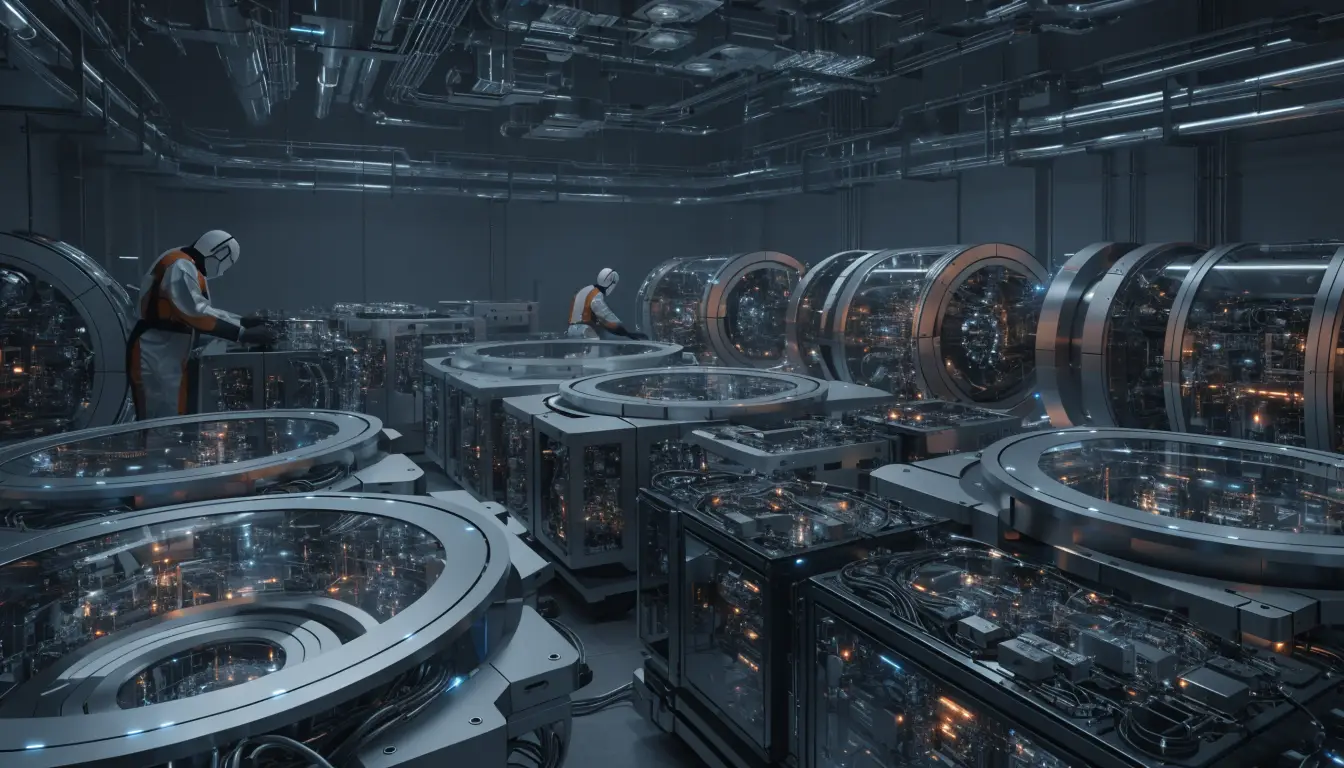
The key driver of this growth can be found in the technological breakthroughs by New York-based IBM. The ‘Condor’ 1,121-qubit processor, announced by IBM in December 2025, demonstrates a 2.6-fold performance improvement over the previous 433-qubit ‘Osprey’, reaching a level applicable to solving real business problems. More importantly, IBM has begun offering this system as a cloud service, allowing companies to access quantum computing power at a rate of $4,500 per hour. This represents a revolutionary improvement in accessibility compared to the $15 million cost of building an on-premises quantum system.
Google, based in Mountain View, California, also achieved significant progress in quantum error correction with its ‘Willow’ chip, unveiled in late 2025. Although composed of 105 physical qubits, the Willow chip successfully reduced the error rate to 0.1%, half of the previous level. This surpasses the critical threshold necessary for practical quantum applications, with Google’s benchmark tests reporting that calculations taking the best-performing supercomputer 10²⁵ years (10 trillion trillion years) were completed in just five minutes.
Interest in quantum computing is also surging in the Korean market. Samsung Electronics, based in Suwon, announced plans in November 2025 to establish a dedicated manufacturing line for quantum processors through its foundry division, with an initial investment of 800 billion won. This investment aims to apply existing semiconductor manufacturing technologies to produce quantum computing hardware, focusing particularly on securing mass production technology for quantum chips operating in cryogenic environments. Industry insiders predict Samsung’s entry could reduce quantum hardware costs by 30-40% compared to current levels.
The Quantum Revolution in Finance and Pharmaceuticals
As the practical business applications of quantum computing rapidly increase, competitive advantages in specific industries are becoming clear. In the financial services sector, JPMorgan Chase announced in December 2025 that by applying quantum computing to portfolio optimization algorithms through its partnership with IBM, it achieved a 15% improvement in returns compared to traditional methods. This system analyzes over 10,000 financial products simultaneously, reducing risk calculation time from eight hours to 20 minutes. JPMorgan’s success has spurred quantum investments by other financial institutions, with Goldman Sachs and Morgan Stanley announcing quantum computing investments of $50 million and $42 million, respectively.
The use of quantum computing in the pharmaceutical industry is yielding even more innovative results. Roche, based in Basel, Switzerland, collaborated with Google’s Quantum AI team to apply quantum computing to molecular simulations in drug development. Complex protein folding simulations, which took six months on traditional supercomputers, can now be completed in 72 hours with quantum computers, potentially reducing drug development timelines by an average of 18 months. Roche’s research director explained, “Quantum computing enables precise predictions of the behavior of large molecules composed of over 1,000 atoms, which was previously impossible.”
The practicality of quantum computing is also being demonstrated in logistics and supply chain optimization. DHL, headquartered in Bonn, Germany, partnered with Toronto-based quantum computing startup D-Wave to apply quantum annealing technology to optimize global delivery routes. This system optimizes 2,500 delivery hubs and 50,000 delivery routes in Europe in real-time, reducing fuel costs by 12% and delivery times by an average of 8% compared to existing systems. DHL’s success has triggered quantum investments by competitors like Amazon and FedEx, accelerating the adoption of quantum-based optimization solutions across the logistics industry.
Microsoft, based in Redmond, Washington, is expanding quantum application cases across various industries through its Azure Quantum cloud platform. As of the fourth quarter of 2025, the number of corporate customers on the Azure Quantum platform increased by 180% year-over-year to 3,400, with 340 of them being Fortune 500 companies. Microsoft is particularly promoting a hybrid classical-quantum computing model, providing solutions that efficiently integrate existing computing infrastructure with quantum processors. This approach allows companies to gradually adopt the benefits of quantum computing while protecting their existing IT investments.
Among Korean companies, SK Hynix, based in Icheon, is establishing a unique position in the field of quantum computing memory. SK Hynix is focusing on developing dedicated memory chips for storing and processing control signals of quantum processors, achieving a response speed 100 times faster than conventional DRAM in prototype tests by the end of 2025. This is an essential peripheral technology for the commercialization of quantum computers, providing SK Hynix with an opportunity to become a key supplier in the global quantum ecosystem. The company plans to invest 1.2 trillion won in this field over the next three years.
Challenges and Future Prospects
Despite the rapid advancement of quantum computing, there are still technical and economic challenges to be addressed. The biggest challenge is maintaining the stability of quantum states. Currently, even the highest-performing quantum systems operate only in cryogenic environments (near -273°C) and are extremely sensitive to external vibrations or electromagnetic interference. IBM’s latest systems maintain quantum states for an average of only 100 microseconds, which is still limited for performing complex calculations. Industry experts point out that extending this time to at least 1 millisecond is necessary for practical quantum applications.
Cost issues also remain a major barrier to the widespread adoption of quantum computing. The cost of building a high-performance quantum computer currently ranges from $10 million to $50 million, with annual operating costs of $2 million to $5 million. This is primarily due to cryogenic cooling systems and precision laser control equipment, with power consumption 10-15 times higher than that of typical data centers. While cloud service access alleviates some of these cost burdens, hourly usage fees of thousands of dollars are still burdensome for small and medium-sized enterprises.
The shortage of talent is also a constraint on industry growth. The number of quantum computing experts worldwide is estimated at around 25,000, which is significantly insufficient compared to market demand. Specialists in quantum algorithm development and error correction are particularly scarce, with average salaries in Silicon Valley and Boston ranging from $250,000 to $400,000. In response, major universities like MIT, Stanford, and Oxford are establishing specialized degree programs in quantum computing, but it is expected to take 5-7 more years to supply enough talent.
Nevertheless, the future outlook for quantum computing is very positive. According to the latest research by McKinsey, the impact of quantum computing on the global economy is expected to reach $850 billion annually by 2035. Of this, financial services are projected to create $340 billion, pharmaceuticals and chemicals $210 billion, and logistics and manufacturing $180 billion in value. In particular, the practical application of Shor’s algorithm, which could render current RSA encryption systems obsolete, is expected around 2030, making the development of new quantum-resistant encryption technologies an urgent task.
From an investment perspective, venture capital and government investments in quantum computing are surging. In 2025, global investment in the quantum computing sector totaled $3.4 billion, a 42% increase from the previous year, with the United States accounting for $1.8 billion, China $800 million, and Europe $500 million. The Korean government also announced plans to invest 2 trillion won over the next five years through the ‘K-Quantum 2030’ project, focusing on quantum computing hardware development, software platform construction, and talent cultivation. With active participation from major companies like Samsung Electronics and SK Hynix, Korea is increasingly likely to occupy a significant position in the global quantum computing competition.
Disclaimer: This content is provided for informational purposes only and does not constitute investment advice or solicitation. All investment decisions should be made based on individual judgment and responsibility, and thorough research and expert consultation should be sought when investing in the mentioned companies or technologies.
