The Evolution of Collaborative Robots: A New Paradigm in Manufacturing Automation by 2026
 Editor
As of early 2026, the collaborative robot (Cobot) market is experiencing unprecedented growth, establishing itself as the new standard in global manufacturing automation. According to the latest report from the International Federation of Robotics (IFR), the collaborative robot market reached $15 billion in 2025, marking a 35% increase from the previous year. Notably, while the traditional industrial robot market has an annual growth rate of 8%, collaborative robots are achieving an explosive growth rate of 42%. This growth is driven by the rapid advancement of AI technology, innovations in safety sensor technology, and, most importantly, the increasing demand for automation among small and medium-sized enterprises.
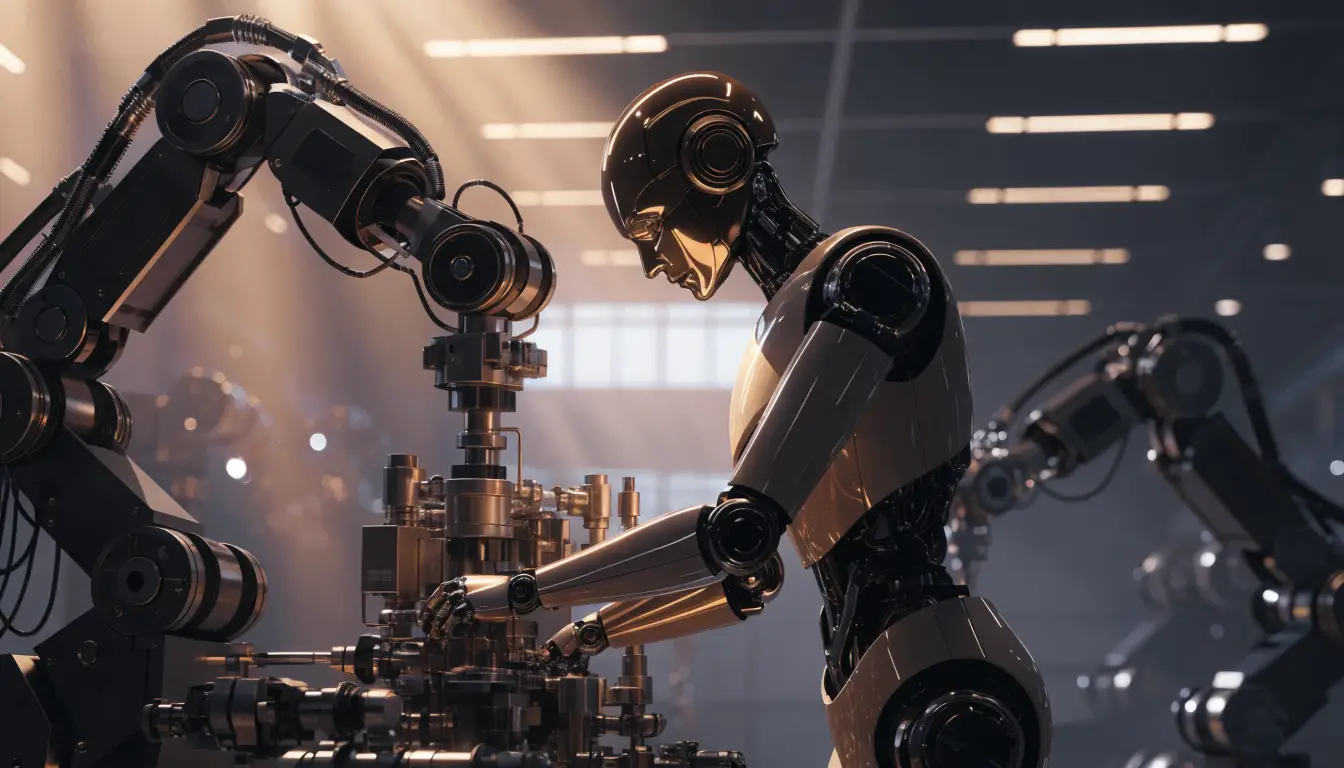
The key differentiator of collaborative robots is their ability to work alongside humans in the same workspace without safety fences, unlike traditional industrial robots. This technology, first commercialized by Denmark’s Universal Robots in 2008, now meets ISO 10218 and ISO/TS 15066 safety standards, allowing safe operation within 80 cm of human workers, thanks to advancements in torque sensors, vision systems, and collision detection algorithms. The latest collaborative robots can detect collisions within 1.5 seconds and stop operations within 0.3 seconds, significantly enhancing worker safety.
In terms of market share, Denmark’s Universal Robots maintains its lead with 32% of the global market. However, Asian companies have been rapidly catching up over the past two years. South Korea’s Doosan Robotics climbed to second place with an 18% market share in 2025, followed by Japan’s FANUC at 15% and Switzerland’s ABB at 12%. Notably, Doosan Robotics achieved an average annual revenue growth of 67% after its KOSDAQ listing in 2023, reaching 850 billion won in sales by 2025 through continuous technological investment and global expansion.
From a technological perspective, 2025-2026 marks a turning point for collaborative robots. The most notable development is the integration of generative AI and large language models (LLM) into robot control systems. The π0 (Pi-Zero) model developed by Silicon Valley startup Physical Intelligence in California can directly convert natural language commands into robotic actions, significantly simplifying the previously complex programming process. Collaborative robots equipped with this technology can perform complex tasks with simple natural language commands like “assemble the parts on the table.”
Practical Changes in Manufacturing and ROI Analysis
The tangible effects of implementing collaborative robots are confirmed by specific figures. According to a 2025 study by Germany’s Fraunhofer Institute, small and medium-sized manufacturers that adopted collaborative robots saw an average productivity increase of 47% and a 23% reduction in defect rates. A noteworthy case is ZF Friedrichshafen, an automotive parts manufacturer in southern Germany. In 2024, the company restructured its gearbox assembly line by introducing 150 ABB GoFa collaborative robots, reducing assembly time from 8 minutes to 5.2 minutes and achieving annual cost savings of 42 million euros.
The spread of collaborative robots is also accelerating in the Korean market. Hyundai Motor Company introduced 280 Hyundai Robotics HH4 collaborative robots at its Ulsan plant in 2025, improving the precision of the body welding process to within 0.1mm. This represents a 300% improvement in precision compared to traditional labor-intensive work. Additionally, Samsung Electronics’ Suwon plant operates a smartphone component assembly line using 450 Doosan Robotics M1013 models, increasing hourly production from 1,200 to 1,850 units, a 54% increase.
In terms of return on investment (ROI), the appeal of collaborative robots is even more pronounced. According to a 2025 analysis by Boston Consulting Group, the average payback period for collaborative robots is 18 months, half that of traditional industrial robots, which is 36 months. This is due to the relatively low initial investment cost of collaborative robots (an average of $80,000 versus $250,000 for industrial robots) and their quick installation and operational capabilities. For small and medium-sized enterprises, the ability to introduce automation without significantly altering existing production lines is a major attraction.
From a market segmentation perspective, the automotive industry remains the largest consumer of collaborative robots, accounting for 34% of the total market. However, the fastest-growing sectors are electronics assembly (58% annual growth) and food packaging (52%). The adoption of collaborative robots in the food industry has rapidly expanded, especially after COVID-19, due to heightened hygiene management requirements. In 2025, Dutch food processing equipment manufacturer MAJA introduced KUKA’s LBR iiwa collaborative robots to its meat processing line, reducing cross-contamination risk by 89%.
Technological Innovation and the Emergence of Next-Generation Collaborative Robots
As of 2026, the most notable innovation in collaborative robot technology is the integration of multimodal AI and real-time learning capabilities. Japan’s FANUC equipped its CRX-25iA model, released in the second half of 2025, with a proprietary “Adaptive Learning System.” This system can detect changes in the work environment in real-time and automatically adjust motion patterns, reducing programming time by 73% compared to previous models. Furthermore, this robot can observe and learn from the movements of workers to develop optimal collaboration patterns on its own.
Advancements in sensor technology have also significantly contributed to the performance of collaborative robots. The next-generation torque sensor developed by Germany’s KUKA can detect minute force changes as small as 0.01Nm, greatly expanding its applicability in precision assembly tasks. Additionally, collaborative robots equipped with 3D LiDAR sensors developed by Israel’s sensor specialist Mobileye can detect obstacles in all directions, enabling safe movement and operation in complex manufacturing environments.
The standardization of software platforms is also an important trend. With the emergence of integrated platforms based on Robot Operating System (ROS) 2.0, collaborative robots from different manufacturers can now cooperate within a single system. “Flow State,” developed by U.S. robotics software company Intrinsic (a subsidiary of Google), can control up to 50 different collaborative robots through a single interface, significantly enhancing its utility in large-scale manufacturing lines.
Innovations in battery technology have also greatly improved the practicality of mobile collaborative robots. Collaborative robots equipped with new lithium iron phosphate (LFP) batteries developed by China’s battery manufacturer CATL can operate continuously for 12 hours and recover 80% capacity in just 30 minutes with fast charging. This greatly increases the utility of collaborative robots in manufacturing environments that require 24-hour continuous operation.
From a global supply chain perspective, the diversification of supply for key components of collaborative robots is underway. The production of precision reducers, previously concentrated in Japan and Germany, is expanding to include companies like Harmonic Drive in Korea and Green Harmonic in China, improving supply stability. Additionally, to address semiconductor shortages, major collaborative robot manufacturers are strengthening supply chain risk management by increasing chip inventories from 6 to 18 months.
However, along with these technological advancements, new challenges are emerging. The biggest concern is cybersecurity risks. Collaborative robots connected to networks can become targets of hacking attacks, as evidenced by a 2025 incident where a collaborative robot system at a German automotive parts plant was hit by a ransomware attack, halting production for three days. In response, major manufacturers are introducing collaborative robot security certification programs, and the International Organization for Standardization (ISO) plans to release the collaborative robot cybersecurity standard (ISO 27001-R) in 2026.
Concerns about workforce displacement also persist. According to a 2025 report by the International Labour Organization (ILO), the introduction of collaborative robots is expected to change or eliminate approximately 2.3 million manufacturing jobs worldwide. However, it is also projected to create 1.8 million new jobs in fields such as robot programming, maintenance, and system integration. Consequently, major countries are expanding retraining programs for manufacturing workers, with Germany planning to provide collaborative robot operation training to 500,000 manufacturing workers by 2026.
In summary, the collaborative robot market is expected to maintain an average annual growth rate of 38% from 2026 to 2030, expanding to $65 billion by 2030. The Asia-Pacific region is anticipated to lead this growth, accounting for 45% of the total market. Technologically, advancements in AI and machine learning will significantly enhance the autonomy and adaptability of collaborative robots, while the spread of 5G and edge computing will further strengthen real-time collaboration capabilities. These changes are expected to expand the application areas of collaborative robots beyond manufacturing to various industries such as services, agriculture, and construction, ultimately enabling the establishment of a new industrial ecosystem where humans and robots collaborate as true partners.
